 By Admin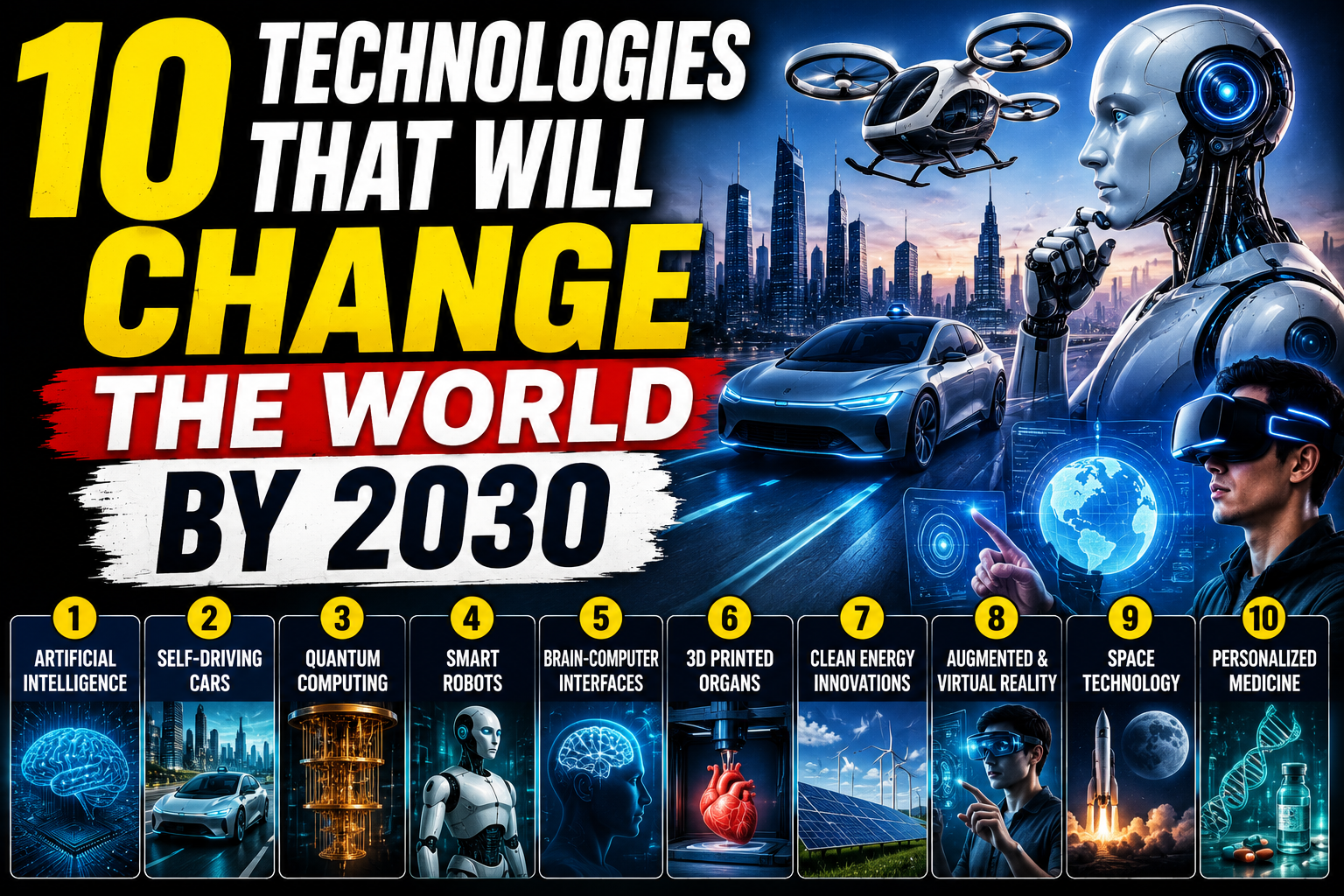
By 2030, the tech we use will stop feeling like “Technologies” and start feeling like life. The biggest shifts are already in motion. They are not about flying cars. They are about applied intelligence, faster networks, cleaner energy, smarter health, and new ways to earn, learn, and travel. If you want to future-proof your career, your business, or simply your peace of mind, these are the 10 areas to watch.
1. Applied AI Technologies that actually does work
Artificial intelligence is moving from demos to daily operations. By 2030, AI will be embedded in tools for writing, design, coding, customer support, and decision-making. It will not just generate content. It will run workflows, analyze data, and suggest actions in real time. Expect AI copilots in everything from spreadsheets to medical records, helping people do more with less friction.
2. Zero-latency connectivity and 6G
Faster networks change what is possible. As 5G matures, early 6G deployments will begin to appear, promising dramatically higher speeds and far lower latency. The impact is not just quicker downloads. It is real-time collaboration at scale, smoother holographic calls, and devices that talk to each other without lag. This is the backbone for autonomous systems, smart cities, and immersive experiences that feel natural.
3. ACES vehicles: autonomous, connected, electric, shared
Transportation is shifting toward a four-letter model: ACES. Vehicles will be more autonomous, tightly connected to infrastructure, fully electric, and increasingly shared. Ride-hailing and micro-mobility will blend with public transit. Cities will redesign streets for safety and efficiency. For drivers, that means fewer accidents and lower costs. For commuters, it means options that save time and stress.

4. Biotechnology and gene editing
CRISPR and related tools are moving from labs to clinics. By 2030, gene editing will enable more precise treatments for inherited diseases, while biotech advances will improve diagnostics and personalized medicine. Agriculture will see hardier crops and better yields. The result is not a sci-fi future. It is earlier detection, fewer side effects, and treatments tailored to your biology.
5. Climate tech and carbon removal
The climate crisis is forcing innovation at speed. Carbon capture, advanced renewables, and smarter grids will scale up this decade. Expect more efficient solar panels, better battery storage, and industrial processes designed to cut emissions. Climate tech will not solve everything alone, but it will bend the curve. For households, that means lower energy bills and more resilience during extreme weather.
6. Quantum computing for hard problems
Quantum computers will not replace your laptop. They will tackle specific, complex problems that classical machines struggle with. By 2030, quantum systems will aid in drug discovery, materials science, and high-stakes optimization. Industries that rely on modeling—finance, logistics, pharmaceuticals—will gain an edge. The ripple effect will be better medicines, lighter materials, and more efficient supply chains.
7. Cloud and edge computing working together
Cloud will keep growing, but the real shift is edge computing: processing data closer to where it is created. Factories, hospitals, and retail locations will run more intelligence locally, reducing latency and bandwidth costs. Combined with cloud, this hybrid model will power real-time analytics, predictive maintenance, and immersive apps. For businesses, that means faster decisions and fewer outages.
8. Immersive reality for work, learning, and play
Extended reality (XR)—augmented, virtual, and mixed reality—will move beyond gaming. By 2030, training, design reviews, remote collaboration, and education will use immersive 3D environments. You will attend meetings as avatars, practice skills in simulated spaces, and visualize complex data in ways that feel physical. The line between “online” and “in person” will blur in useful ways.
9. Cybersecurity powered by AI
As systems get smarter, so do threats. AI-driven cybersecurity will become essential to detect anomalies, respond to attacks, and harden networks in real time. Expect automated defenses that learn from patterns and adapt faster than human teams alone. For everyday users, that means fewer breaches and smoother authentication. For companies, it is the difference between a minor alert and a headline-making incident.

10. No-code and low-code software
Building software will not require a computer science degree. No-code and low-code platforms will let non-technical teams create apps, automate processes, and integrate data with drag-and-drop tools. By 2030, more business workflows will be built by the people who actually use them. This shifts power inside organizations and speeds up innovation without waiting for dense IT backlogs.
What this means for you
These technologies will not arrive all at once. They will layer in, quietly changing how you pay, learn, commute, and stay healthy. The common thread is practicality. AI will handle routine tasks. Networks will get faster and more reliable. Energy will get cleaner. Health will get more personal. Software will get easier to build and safer to run.
If you are planning for the next five years, focus on skills that work with these shifts: data literacy, basic automation, digital security habits, and comfort with new tools. For businesses, the winners will be those who adopt early, train teams, and redesign processes around what these technologies enable.
The future is not a distant headline. It is the next upgrade you accept, the next app you install, the next payment you make without thinking. These 10 technologies will change the world by 2030, and they will start by changing your Tuesday.
News which you won’t want to miss
- B&M and Home Bargains Chocolate Recall: Urgent Allergy Warning Over Missing Ingredient Labels
- Council Tax Reforms 2027: New Rules Give Vulnerable Households More Time and Protection
- Jimmy Kimmel vs Trump: Controversy Over Joke Sparks Debate on Free Speech and Responsibility
- Allbirds AI Pivot Explained: Why the Struggling Sneaker Brand Is Betting Big on Artificial Intelligence
- EasyJet Refund Controversy: Family’s £4,000 Dispute Sparks Debate Over Airline Compassion Policies