 By Admin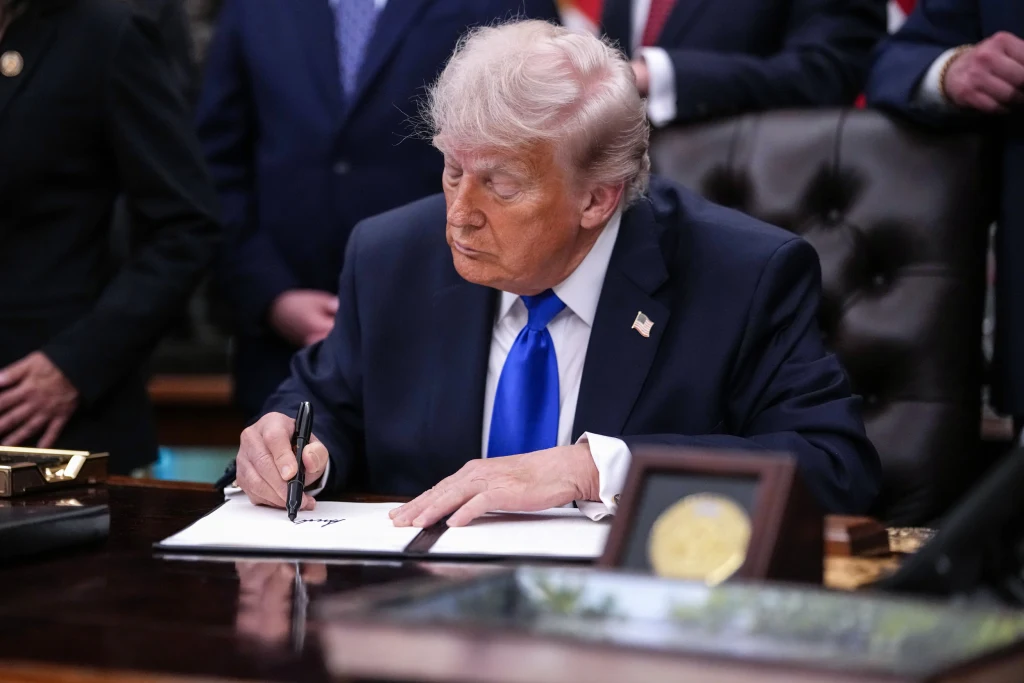
President Donald Trump has signed an executive order that could reshape how tens of millions of American workers save for retirement. The move, announced in the Oval Office Thursday, puts a concrete plan behind a proposal Trump first introduced in his State of the Union address in February. At its core, the order is designed to help close the “retirement coverage gap”—a long‑standing problem that has left more than 50 million mostly low‑ and moderate‑income workers in the private sector without any real, easy way to save for later life.
For many of these workers—employees at small businesses, part‑time staff, independent contractors, and the self‑employed—retirement planning has meant either going it alone with a standard IRA or doing nothing at all. Trump’s executive order aims to change that by creating a new, low‑cost, easy‑to‑use retirement pathway through a federal‑style IRA model: TrumpIRA.gov.
What TrumpIRA.gov Will Offer
Under the order, starting next year workers will be able to open a new IRA account through a government‑designated website, TrumpIRA.gov. The administration frames these accounts as the retirement equivalent of what federal employees already enjoy through the Thrift Savings Plan: low‑cost, diversified, and straightforward investment options administered at minimal expense.
The executive order spells out strict cost limits for the IRA providers that will appear on the site. The overall annual expense ratio—covering management fees, operating costs, and administrative expenses—is capped at no more than 0.15% of an account’s balance. The providers are also barred from imposing minimum contribution or minimum balance requirements. That means a retail worker making a few hundred dollars a month can open an account and start saving, even if they can only put in a small amount at a time.
The goal is to make the accounts feel less like a “Wall Street” product and more like a basic public‑service tool, similar to how people think of Social Security or 401(k)s at larger companies. By cutting out many of the hidden fees and barriers, the administration hopes to draw in the millions of workers who have never had access to a workplace retirement plan or have avoided IRAs because they seem complicated or expensive.
The Federal Saver’s Match and Incentives to Save
The executive order also leans heavily on the federal Saver’s Match, a retirement‑incentive program passed during the previous administration that goes into effect next year. Under the Saver’s Match, low‑ and moderate‑income workers who earn less than $35,500 (or $71,000 for a married couple) can receive a matching contribution of up to $1,000 from the federal government—up to $2,000 for couples—if they contribute up to $2,000 per year ($4,000 for couples) into a qualified retirement account such as a 401(k), IRA, or an auto‑IRA.
Trump’s order directs federal agencies to increase public awareness of the Saver’s Match, using outreach campaigns, tax‑season notices, and other channels to make sure eligible workers know the benefit exists. The idea is simple: when people see that every dollar they save can be “multiplied” by the match, they may be far more willing to start and keep contributing.
A Pew Charitable Trusts analysis cited during the rollout found that last year, 87% of workers without access to a retirement plan at work said they would be more likely to save if they could receive the match. That kind of psychological nudge has long been one of the most powerful tools in retirement‑policy design, and the Trump administration is betting it will turn TrumpIRA.gov from a niche option into a widely used program.

The Limits of a Voluntary System
The order goes a step further by asking Congress to “codify the policy” so that workers without employer‑sponsored plans would have a permanent, low‑fees retirement option, featuring the Saver’s Match (or similar matching contributions), diversified index‑based funds, automatic portfolio choices, and easy portability between jobs. In other words, the administration is pushing lawmakers to turn the executive‑order framework into a long‑term statute rather than a one‑president‑era experiment.
However, there is a key limitation: the current plan is voluntary. The executive order does not give the administration the authority to auto‑enroll workers into these accounts, a move that typically requires explicit Congressional authorization. A recent Morningstar analysis modeled the effect of a federal auto‑enrollment plan and estimated that about 32.3 million workers would enter the retirement‑saving system, even after accounting for opt‑outs.
Because TrumpIRA.gov is built on voluntary participation, the number of people who actually sign up—and who see meaningful changes in their retirement balances—could be far lower than what an automatic system would produce. Some experts also worry that a voluntary program may not do enough for the hardest‑to‑reach populations, such as gig workers, those in cash‑pay jobs, or people who distrust government schemes.
Who Benefits Most—and Who Might Be Left Behind
The executive order explicitly targets workers who have historically been left out of retirement‑savings systems: small‑biz employees, part‑time staff, nonwhite workers, and those without access to 401(k)s or pensions. The fact that 78% of firms with fewer than 10 employees do not offer employer‑based plans, according to AARP, shows just how wide the gap really is.
If the marketing and education push around the Saver’s Match are effective, and if the low‑fee structure of TrumpIRA.gov lives up to its promise, the policy could materially improve retirement preparedness for a large slice of the workforce. But whether it lives up to that potential will depend on how well people understand the product, whether they trust it, and whether Congress ultimately chooses to lock it in with a broader legislative framework.
For now, the executive order is a signal that the administration wants to make retirement savings feel more like a “normal” part of work life, even for those who have never had a benefits package. If executed well, it could become one of the most quietly significant steps in a generation toward closing the retirement‑coverage gap in the U.S.
News which you won’t want to miss
- B&M and Home Bargains Chocolate Recall: Urgent Allergy Warning Over Missing Ingredient Labels
- Council Tax Reforms 2027: New Rules Give Vulnerable Households More Time and Protection
- Jimmy Kimmel vs Trump: Controversy Over Joke Sparks Debate on Free Speech and Responsibility
- Allbirds AI Pivot Explained: Why the Struggling Sneaker Brand Is Betting Big on Artificial Intelligence
- EasyJet Refund Controversy: Family’s £4,000 Dispute Sparks Debate Over Airline Compassion Policies